Sheikh Hasina and Bangladesh's Prospects for Democracy
Bangladesh is necessary. It consistently participates in exercises alongside the U.S. Indo-Pacific Command and is the biggest single contributor to U.N. peacekeepers. Businesses and artistic communities in Asia, Europe, and the Americas rely heavily on its dynamic diaspora. The US is the main market for Bangladeshi exports and the largest place for foreign direct investment. Hasina has additionally shown herself to be valuable to the West as one of the few leaders of the developing world to denounce Vladimir Putin's invasion of Ukraine, despite her tardiness in doing so. She has taken in around one million Rohingya refugees from neighboring Myanmar.
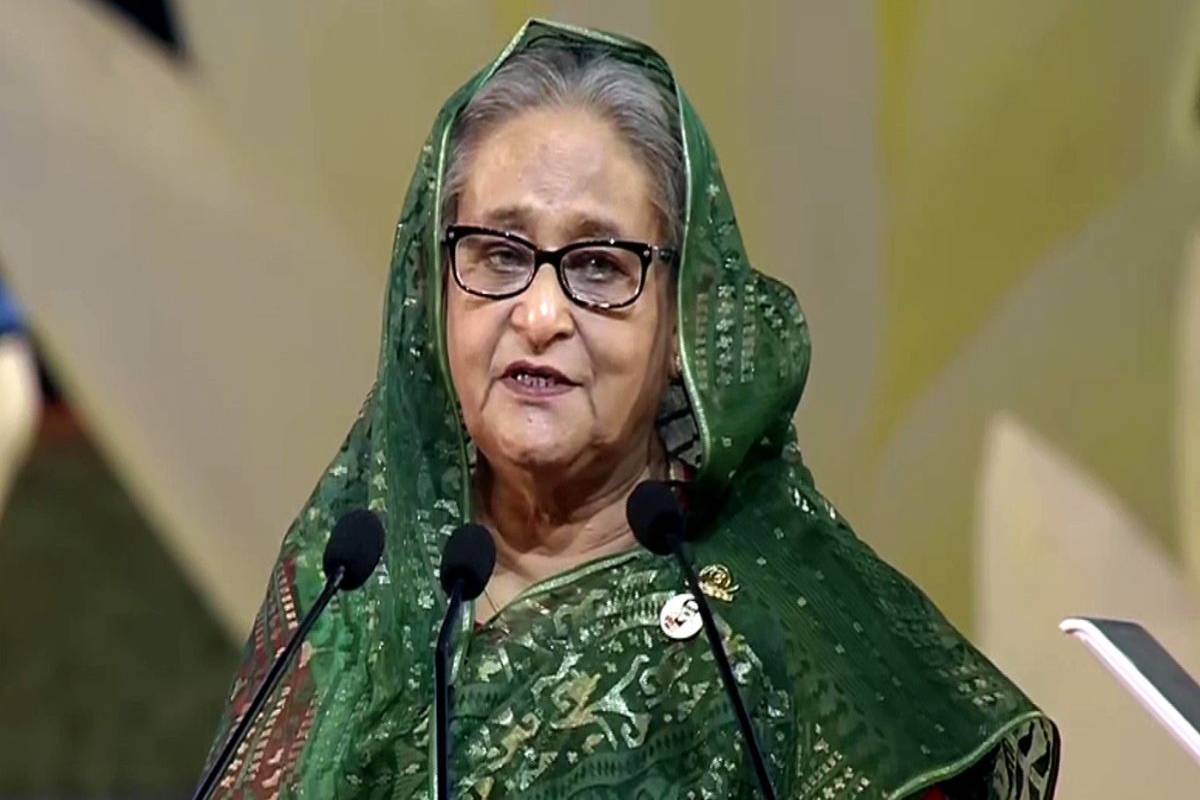
Washington, however, is worried about Bangladesh's trend toward autocracy. The United States announced in May that it would no longer grant visas to any Bangladeshi undermining elections, and Hasina was not invited to the last two Summit for Democracy events. Hasina responded by telling parliament that the United States was "trying to eliminate democracy" by orchestrating her removal. US Ambassador to Bangladesh Peter D. Haas, when questioned about her accusation, maintains that Washington is "scrupulous about not picking sides."
However, the harshness of US official policy is telling at a time when the US is desperate to counter China's expanding regional footprint at every opportunity. Bangladesh appears to have become a test case for the United States' foreign policy of promoting democracy, according to Michael Kugelman, director of the Wilson Center's South Asia Institute. "The biggest risk is that the government will double down and take all necessary measures to maintain its hold on power as a result of all this pressure backfiring."

It is a contentious question to wonder what four terms in a row for Hasina would mean for Bangladesh. The majority of Americans are only familiar with the nation through labels sewed into their t-shirts and jeans, but it's a melting pot where a sizeable minority of roughly 10% of Muslims coexist with a population that is more Muslim than any other country in the Middle East. In 1988, despite the country's secular constitution, a military dictatorship declared Islam the official religion, a contradiction that has served as a breeding ground for extreme fundamentalists.
Hasina has accomplished remarkable things economically. Bangladesh's GDP increased from $71 billion in 2006 to $460 billion in 2022, making it the second largest economy in South Asia after India. From a country that struggled to feed its people, Bangladesh is now a major food exporter. Social indicators have improved as well; today, 98% of girls complete primary school. Bangladesh is entering the high-tech manufacturing space, which is enabling multinational companies such as Samsung to remove their supply chains from China. "Obviously, there is room for improvement in the areas of democracy, human rights, and free speech," states Professor Mohammad Ali Arafat, a central Dhaka lawmaker for the Awami League. However, we have made great progress.

Bangladesh is likewise in the forefront of the climate emergency. Although the country that was once known as East Pakistan was formed during the crackling and smoke of a civil war in 1971, water has ruled this region's way of life for thousands of years. An astounding 165 trillion gallons of snowmelt from the high Himalayas each year flow through Bangladesh's rivers from the interior. Almost $1 billion worth of damage is caused every year by frequent cyclones that pound a low-lying delta that is 80% floodplain from the skies. Furthermore, the lives and livelihoods of a population more than four times the size of California, crammed into an area smaller than Illinois, are increasingly in danger due to rising sea levels. Hasina has led the push for rich nations to give their developing counterparts $100 billion a year until 2025.
If water governs Bangladeshi life, then blood dominates its politics. Two families and the women who currently head them have been embroiled in a savage feud for the past fifty years. Hasina, the daughter of Bangladesh's first president Sheikh Mujibur Rahman, commonly referred to as Sheikh Mujib, is pictured on one side. Sheikh Mujib and 17 of his close relatives were killed in an army coup in 1975. It's likely that Hasina only made it because she was in Europe at the time. Khaleda Zia, the widow of former army chief and BNP founder Ziaur Rahman, is on the side of the opposition. Rahman led the nation from Mujib's murder until his own in 1981.
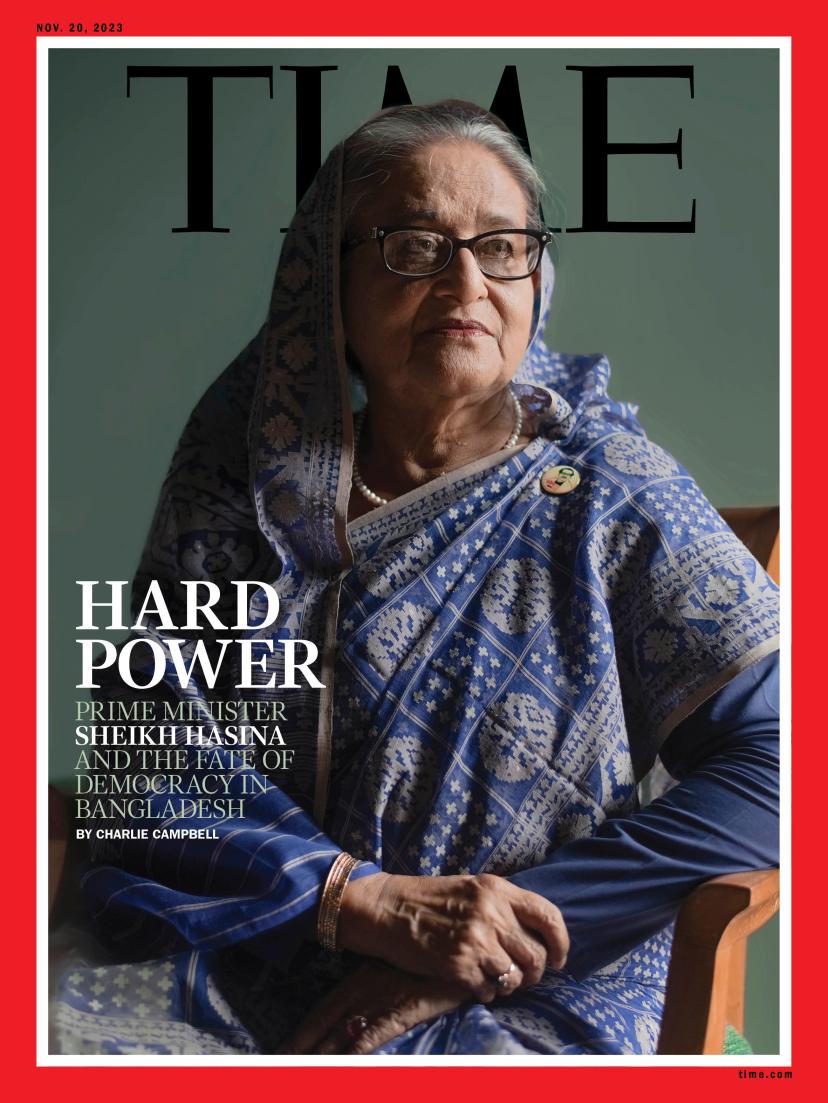
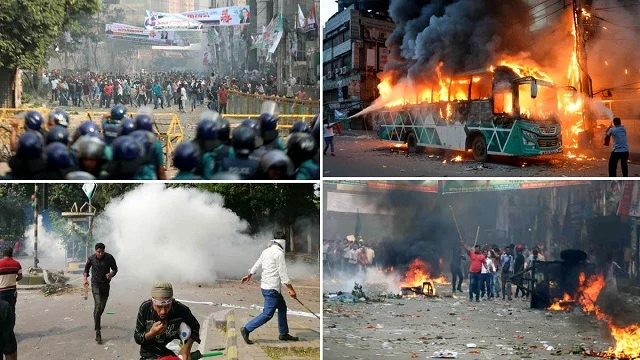
While downplaying each other's contributions, these dynastic matriarchs find approval in their families' roles in Bangladesh's liberation struggle. Hasina attacks the BNP, pointing out that it was founded by a previous junta, calling it a "terrorist party" that "never conceived in democracy." "Khalid Zia governed akin to a military dictatorship," she venomously remarks. Hasina draws attention to the violence committed by BNP supporters in their arson attacks after the contentious 2018 election. In contrast, the BNP highlights the systematic suppression of their party and fabricates accusations against its leaders. Bloodletting is, regrettably, widespread on all fronts. Street violence has frequently been a part of Bangladeshi politics, according to Meenakshi Ganguly, a Human Rights Watch's deputy director for Asia. "That holds true for every significant political party."
As proof of her commitment to free elections, Hasina points to her government's introduction of open ballot boxes and voter registration forms connected to ID cards and biometric information. She also asserts that democracy is ingrained in her DNA. Hasina and her sister sought safety in the residence of Bangladesh's ambassador to West Germany following the death of their father. Eventually, they were granted political asylum in India. (She wed physicist M. A. Wazed Miah in 1967; the couple had two kids before he passed away in 2009.) After being attacked by thousands of the Awami League's supporters in 1981, Hasina was finally allowed to return to Bangladesh. She then spent the next few years advocating for free elections and an end to military rule. It was a struggle for us, she claims. "This
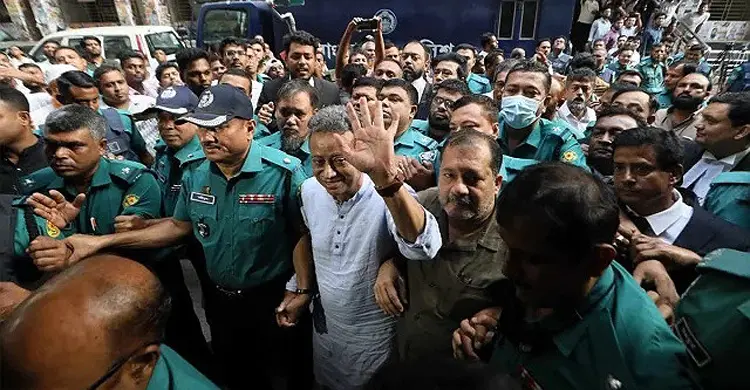
However, a lot can happen in forty years, and the opposition in Bangladesh is currently complaining that they cannot campaign in public or in the media without fear of being detained, attacked, or facing legal repercussions. According to Ambassador Haas, "it's not just the actual day of elections that matters for free and fair elections." "It's the whole process and surroundings that precede it."
Every election between 1991 and 2008 saw the BNP and Awami League exchange positions of power, and anti-incumbency sentiment alone makes it likely that Hasina would be ousted in a fair vote. One Dhaka rickshaw the driver told TIME, "Today people are suffering," asserting that his 400 taka ($3.50) per day hardly covers the cost of lentils and oil for cooking for his wife and two kids. Hasina comes from a wonderful family, but her father is unable to assist us at this time.
Hasina's main concern is that, should she be ousted from office, she would probably face the same kind of oppressive reprisals that her government presently imposes. Zillur Rahman, a talk show host and executive director of the Centre for Governance Studies think tank located in Dhaka, claims that the Awami League is terrified. "There's no safe way out for them."

The events of July 1, 2016, had a significant influence on Bangladesh's oppressive security environment. Five men carrying bombs, handguns, assault rifles, and machetes stormed Holy Bakery in Dhaka's affluent Gulshan neighborhood at 9:40 p.m., a gathering place for local embassy employees and the elite of Bangladesh. Shouting "Allahu Akbar," which means "God is great" in Arabic, they let loose with grenades and opened fire on the mostly foreign patrons. While terrified employees ran across rooftops or locked themselves in a restroom, customers dove under tables.
As per eyewitnesses, the attackers expressed their dissatisfaction over Westerners' skimpy attire and alcohol consumption habits, claiming they were an encouragement to the locals to follow suit. Afterwards, they killed or tortured every captive who was unable to recite the Koran. Twenty-two civilians, mostly locals, Italians, and Japanese, five terrorists, and two police officers were confirmed dead when the siege was eventually broken by a police raid. Fifty more people, mostly police, were hurt.

After over 30 violent attacks targeting Hindus, academics, and secularist writers and bloggers in the preceding year, it was the lowest point in a wave of Islamic terrorism inspired by ISIS that engulfed Bangladesh. The culture of fear spread to the point where many restaurants forbade foreign patrons for fear of becoming targets again. The leafy street where that carnage took place is now home only to opulent condos and a medical facility. Even so, Hasina's ongoing security crackdown has legitimacy thanks to the memory of the violence.
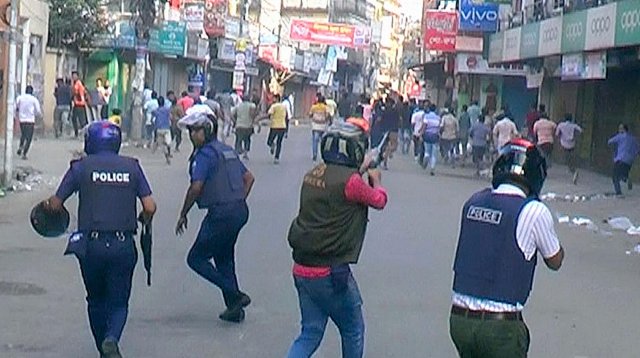
Ziaur Rahman started Bangladesh's Islamization process in earnest in 1977, and his BNP is still associated with more conservative groups today, while the country's religious minorities have historically supported the Awami League. According to Kugelman of the Wilson Center, "Dhaka has used counterterrorism imperatives as a pretext to crack down harder on the Islamist elements of the opposition." Today, counterterrorism serves as a justification for widespread state repression. Ganguly describes police actions at recent BNP rallies as "provocative... which has of course led to retaliation."
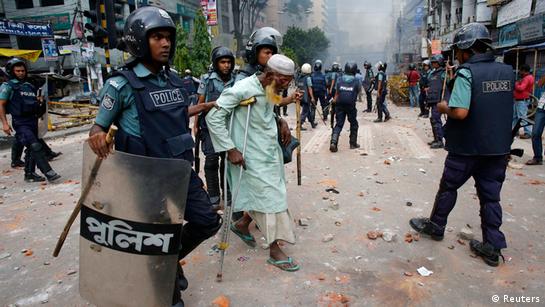
It's not just rocks and sticks on the street, though; Hasina's alleged enemies are increasingly the target of Bangladesh's legal institutions. Two well-known human rights advocates who documented extrajudicial killings and disappearances were sentenced to two years in prison on vague charges on September 15, which sparked an outcry from other governments, including the United States. Students, cartoonists, and journalists have all been the target of attacks.
Muhammad Yunus, the 2006 Nobel Peace Prize winner from Bangladesh who invented microcredit as a means of reducing poverty, was the target of "continuous judicial harassment" from Hasina, according to an open letter written in August by more than 170 world leaders and Nobel laureates, including Barack Obama. Hasina, who calls Yunus a "bloodsucker," has filed 174 charges against him, including ones involving money laundering, corruption, and violations of labor laws.
It's an odd personal grudge that fuels claims of smoldering paranoia. Though she rattles off "food, clothing, housing, education, healthcare, and job opportunities," Hasina may maintain that her record is impeccable. "I'm doing it and I have done it," but when you look closer, things aren't quite as perfect as they seem. Bangladesh's economy, according to Freedom House, is still dependent on agriculture, the export of inexpensive clothing, and the approximately $25 billion that the country's 14 million diaspora sends home each year. The remittances have been instrumental in mitigating economic strain, especially in light of the recent surge in fuel and other essential commodity prices following the invasion of Ukraine.
Bangladesh comes in at number 147 out of 180 countries in Transparency International's Corruption Perceptions Index, level with Iran and one spot ahead of the Taliban-ruled Afghanistan. Hasina brags that "everyone has a mobile phone" in Bangladesh these days and that the country is scheduled to leave the United Nations' group of Least Developed Nations in 2026. However, that is a very low bar by any standard; by then, Myanmar, Afghanistan, and Cambodia would be the only Asian members still in existence.
Even though Hasina disparages the "slum people" of Dhaka and claims that the country's picturesque villages represent a "different scenario," it still begs the question of why 2,000 people per day move from the countryside to the congested capital. Ordinary Bangladeshis are suffering from nearly double-digit inflation, and businesses' ability to trade has been hampered by declining foreign reserves. Ambassador Haas describes the country as "a tough place to do business," citing widespread corruption, labor issues, and the currency crisis. "American businesses are also considering investing in twelve other nations. Bangladesh must therefore strive to be competitive.